 Göreme City Guide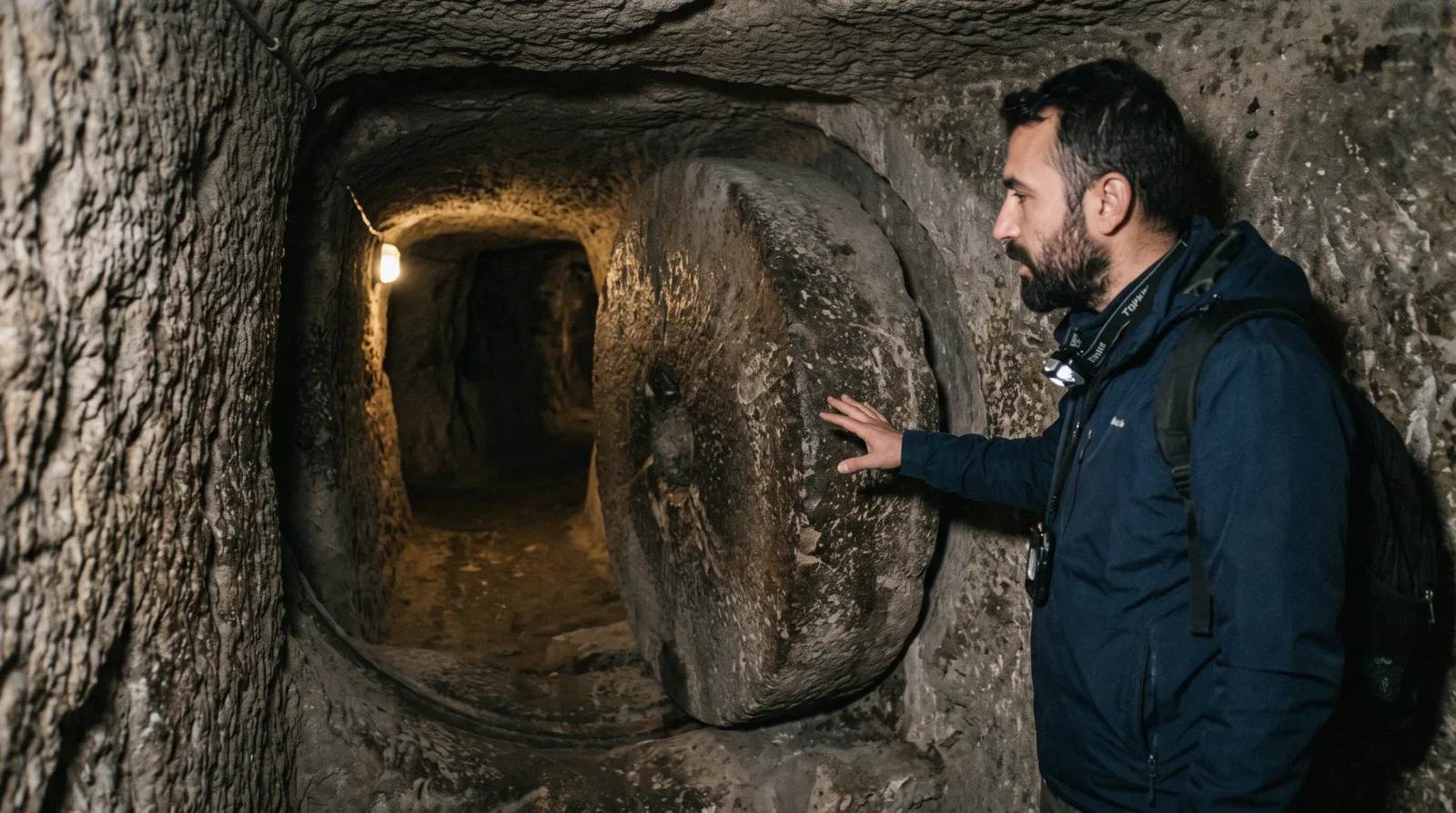
Kaymaklı Underground City
Kaymakli underground city is the widest of the Cappadocia refuges, 8 levels of chambers with 4 open to visitors, 19 km from Nevşehir and the only major sight in the region that keeps its ticket window open into the evening. This page is built around the decision every reader arrives with, Derinkuyu or Kaymaklı, and then walks the four visited floors in order. Tickets are on the underground city tickets page, and the wider plan on the Göreme city guide homepage.
Quick answer Hours, price, floors, and the one decision that matters
Kaymaklı opens 08:00–20:00 daily with no closed day, the longest hours of any ticketed site in the region. An adult ticket is $14.90 (€13). Four of its 8 levels are open, and 45–60 minutes covers them at a steady pace.
Key takeaways
- Picking between the two cities, or pairing them in one day, is the Derinkuyu or Kaymaklı decision this page settles
- Without a car, ride the dolmuş to Nevşehir's otogar and change for the Kaymaklı service, fares unpublished, or take the red and green combined day tour, which lists the underground city among its stops
- The entry options, the pass arithmetic and the honest tour inclusions are on the underground city tickets page
Key facts
Opening hours
| Every day | 08:00–20:00 |
|---|---|
| Ticket office | 08:00–19:15 |
Closed None. On the first day of the religious holidays (Ramazan Bayramı, Kurban Bayramı) state museums open only after midday
Admission
- Adult
- $14.90 (€13)
- Reduced
- Not stated. The Ministry publishes no reduced foreign fare. Turkish citizens enter on Müzekart, a citizens-only card foreigners cannot buy
- Free
- Turkish citizens aged 18 and under and 65 and over, via QR code in the Museums of Turkey app. The free-age threshold for foreign children is not stated
Planning it
- Time needed
- Not stated by the Ministry. Our routing: 45–60 minutes, HistoryHit's generous 2–3 hours included
- Book ahead
- Optional — walk-up usually fine
- Address
- Kaymaklı (Konaklı), 19 km from Nevşehir on the Nevşehir–Niğde road, Nevşehir Province
Four ways in, priced from the official muze.gov.tr e-shop and the tour platforms. The euro figure is what the museum till charges foreign visitors, the dollar beside it is the same money at this site's fixed rate.
Are you choosing a second underground city, or deciding between them?
| Option | Price | Includes | Cancel | Book |
|---|---|---|---|---|
| Official single ticketThe default. There is rarely a queue problem here, the floors move groups through all day | $14.90 (€13) | One entry, undated e-ticket or gate purchase | Not stated as refundable | Official site |
| Red and green combined day tour, 7–8 hOne-day visitors who want both loops covered and accept the pace | $21.07 | Göreme Open Air Museum, the underground city (the listing does not name which), Pigeon Valley and the chimneys, ticket optional | Free cancellation per the platform | Check Availability |
| Guided green tour, 9 hThe south-loop day: if you are choosing one underground city with a guide, this is the Derinkuyu pairing | $20 | Guide, transport, Derinkuyu, Ihlara Valley and Selime. Entry ticket an optional extra at checkout | Free cancellation per the platform | Check Availability |
| Full-day private car and licensed guide, 8 hFamilies and anyone pairing Kaymaklı with the north loop on their own clock | $211.65 | Your routing and timings, guide and vehicle, Kaymaklı included if you name it | Per the platform's terms | Check Availability |
Kaymaklı sells the same €13 ticket as its neighbour, so no platform can sell you a cheaper way in. What they sell is the vehicle and the guide, and on the day-tour listings the entry itself is an optional extra at checkout. All figures are the listed prices read in Q3 2026, they move with the date and the checkout price is the one you pay.
Kaymaklı entry options and day tours compared
Each card opens the operator's own page, where the calendar for your date shows what is still open. Figures are the operators' listed dollars as captured for this guide.
 from $21.07
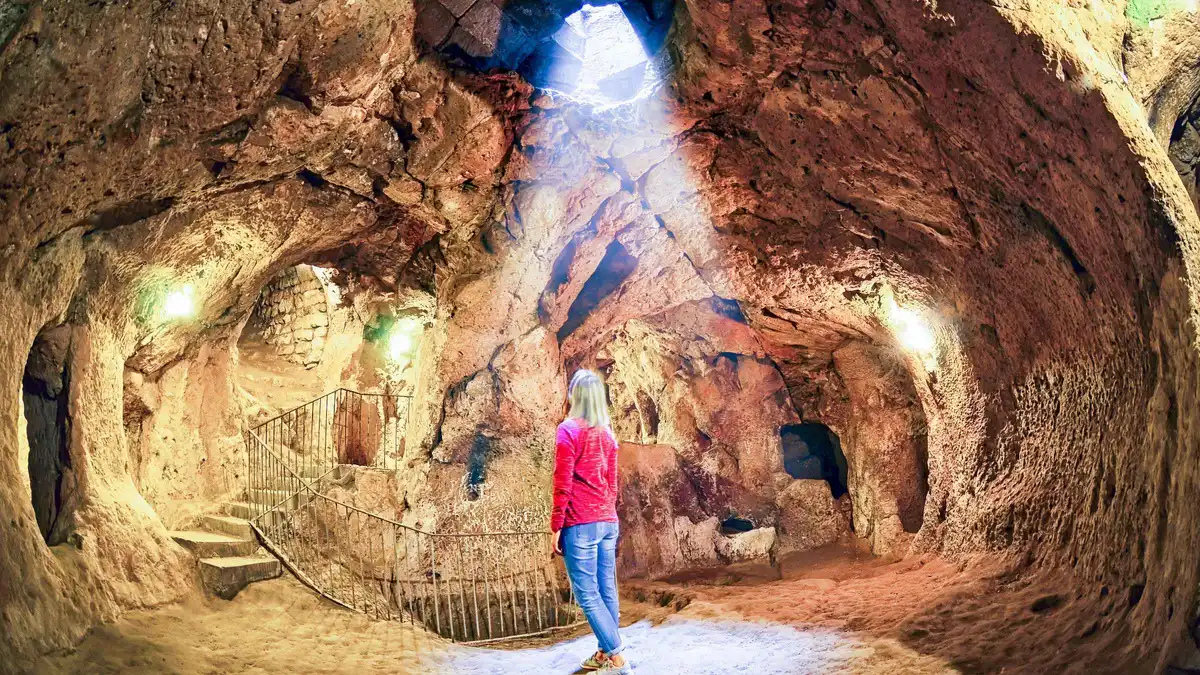
Full Day Cappadocia Red and Green Combined Day Tour
The whole classic loop in one day: the north valleys, the Open Air Museum side, then the underground city and Ihlara on the green half. Entry tickets are extra.
Check Availability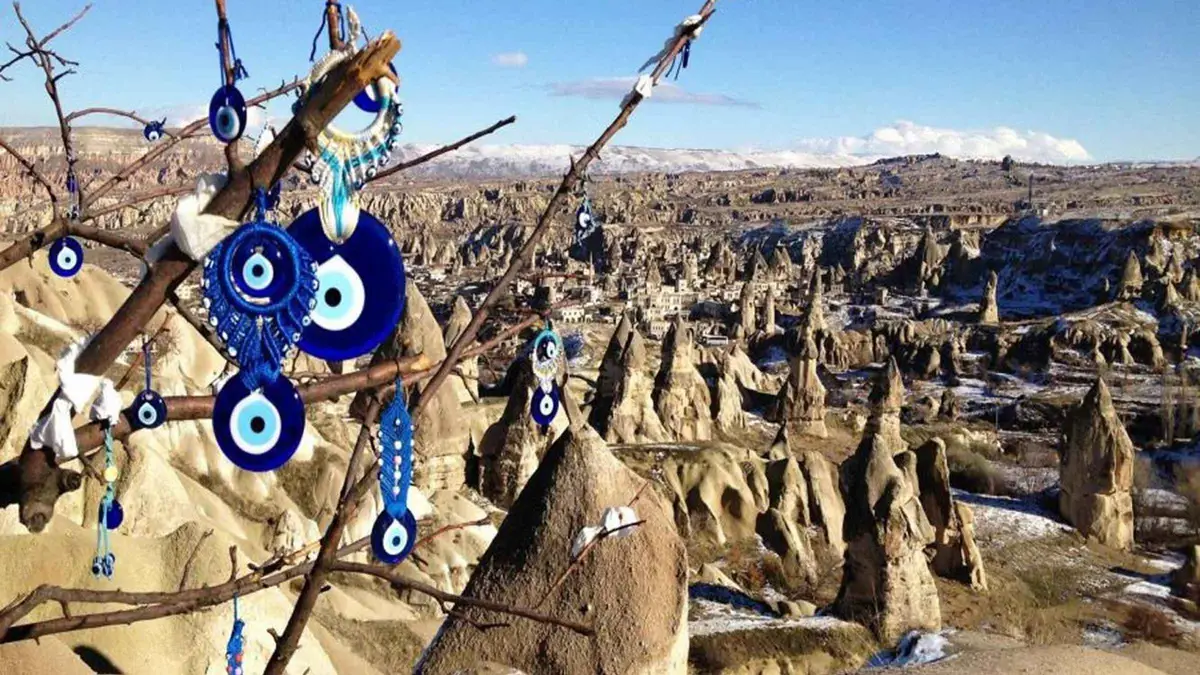 from $20
Cappadocia: Guided Green Tour with optional Lunch and Ticket
The south loop: Derinkuyu underground, the Ihlara gorge walk and the Selime rock massif, with a guide and an optional lunch.
Check Availability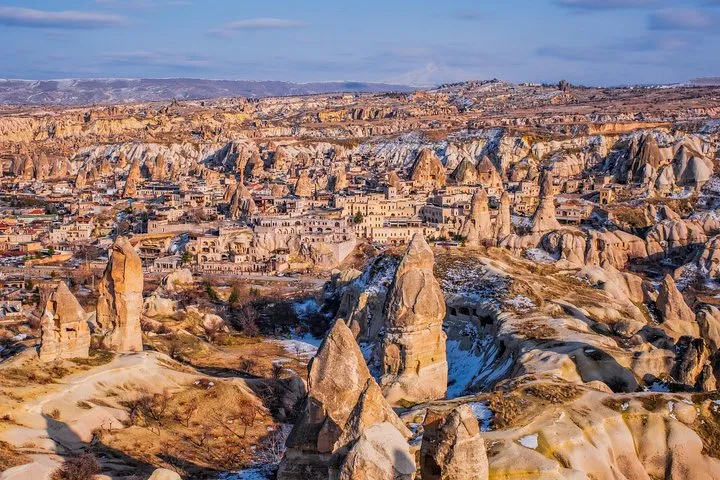 from $211.65
Full-Day Private Cappadocia Tour with Car and Licensed Guide
Your own car and licensed guide for a day, routed to your interests, with the pickup from your Göreme door. Entries and lunch are extra.
Check AvailabilityPrices, ratings and details are the platform's own. dollar figures are the listed prices — the platform bills in your account's currency.
What Kaymaklı Is, And Why It Reads Different
Same volcanic tuff, same refuge purpose, same €13 gate as its neighbour. The difference is the plan of the place, and it is the reason the two visits do not feel like duplicates.
Enegup, the village built on its shelter
The ancient name was Enegup, to Cappadocian Greek speakers Anakou, and Wikipedia locates the city within the citadel of Kaymaklı, 19 km from Nevşehir on the Nevşehir–Niğde road. The village houses still stand around nearly one hundred tunnels of the underground city, and the tunnels are not only heritage: locals use them today as storage areas, stables and cellars, which is why the place reads lived-in rather than excavated. Of the 8 levels the state tourism portal counts, 4 are visitable, and the official wording is honest that only a fraction of the complex is open.
Widest, not deepest, and built around air
The layout is the decision-maker. Wikipedia's description has the tunnels running lower, narrower and more steeply inclined than Derinkuyu's, but every space is organised around ventilation shafts, so the rooms themselves are generous where the connecting passages pinch. HistoryHit goes further and calls Kaymaklı the widest underground city in existence, well-lit and spacious enough that visitors who dislike confined spaces tend to manage it, and it makes the practical point in plain words: it is not a terrible option for claustrophobes.
If Derinkuyu is a descent, Kaymaklı is a circuit with windows, which is why families and nervous first-timers often start here.
The same 1923 story, a different discovery date
The history rhymes with its neighbour's: possible Phrygian first caves in the 8th to 7th centuries BC, an underground city dated to the 8th century AD when Christians dug against invaders and bandits, expansion through the Arab–Byzantine wars, refuge in Timur's era, and abandonment in the 1923 population exchange. The two were even physically connected, by 8–9 km of tunnels neither site lets you walk. Kaymaklı's modern date differs by a year: it opened to tourists in 1964, which both Wikipedia and HistoryHit record, a year after the basement-wall discovery that woke Derinkuyu.
Kaymaklı In Its Dates
Every line carries a date only where a source dates it. The early chronology is a scholarly argument, the modern dates are documented, and the list is ordered so the argument is visible.
-
8th–7th century BC
Possible Phrygian first caves
The Turkish Department of Culture's dating for caves possibly first cut in the soft rock by the Phrygians, stated as a possibility rather than a finding (Wikipedia).
-
8th century AD
The refuge city takes shape
Christians create the underground city to defend themselves from invaders and bandits in a lawless frontier region of Byzantine Cappadocia (Wikipedia).
-
780–1180
Expanded through the Arab–Byzantine wars
Four centuries of Arab raiding deepen and enlarge the city, and the tunnels link it to Derinkuyu, 8–9 km away through the rock (Wikipedia).
-
14th century
Refuge in Timur's era
The underground cities continue to shelter the Christian population from the Mongolian incursions of Timur (Wikipedia).
-
1909
Dawkins records a refuge flight
After the Adana massacres, a great part of the population takes refuge in the underground chambers for some nights (Dawkins 1916, quoted by Wikipedia).
-
1923
The population exchange empties the tunnels
The Christian inhabitants are expelled to Greece and the city is abandoned (Wikipedia).
-
1964
Opened to tourists
Both Wikipedia and HistoryHit date the public opening to 1964, a year before the state tourism portal's date for Derinkuyu.
-
1985
UNESCO World Heritage listing
Kaymaklı becomes part of the Göreme National Park and the Rock Sites of Cappadocia inscription, which names both subterranean cities (HistoryHit, UNESCO via the official facts pack).
Dates as recorded in the Wikipedia history and description sections (citing Dawkins 1916 and the Turkish Department of Culture), HistoryHit's site history, and whc.unesco.org as captured in this site's official facts pack.
Derinkuyu Or Kaymaklı: The Decision
Both charge the same official $14.90 (€13), so the choice costs nothing and comes down to depth versus layout, hours and what else your day pairs with. Figures from the official fee list and the sources named.
| Depth and size, as sourced | Hours | Listed price | Pick it if | |
|---|---|---|---|---|
| Kaymaklı | 8 levels, 4 visitable, rooms organised around ventilation shafts, the widest of the underground cities on HistoryHit's reading | 08:00–20:00 | $14.90 (€13) | You want generous rooms, evening hours, or the calmer first underground city |
| Derinkuyu | 18 tunnel levels, more than 85 m deep, the deepest and largest excavated in Turkey | 08:00–18:45 | $14.90 (€13) | You want the full descent and can handle tight, stooping passages |
The practical split: the standard guided green tour pairs Derinkuyu with the Ihlara gorge to the south, so Kaymaklı is the pick for a self-drive day, for the north loop, or for the after-dinner hour no other ticketed site in the region offers. Derinkuyu carries the full physical honesty about the deep option.
What You Walk Through In Kaymaklı, Floor By Floor
The four visitable levels each have a job, and Wikipedia's archaeological description lets you walk them in order before you buy the ticket.
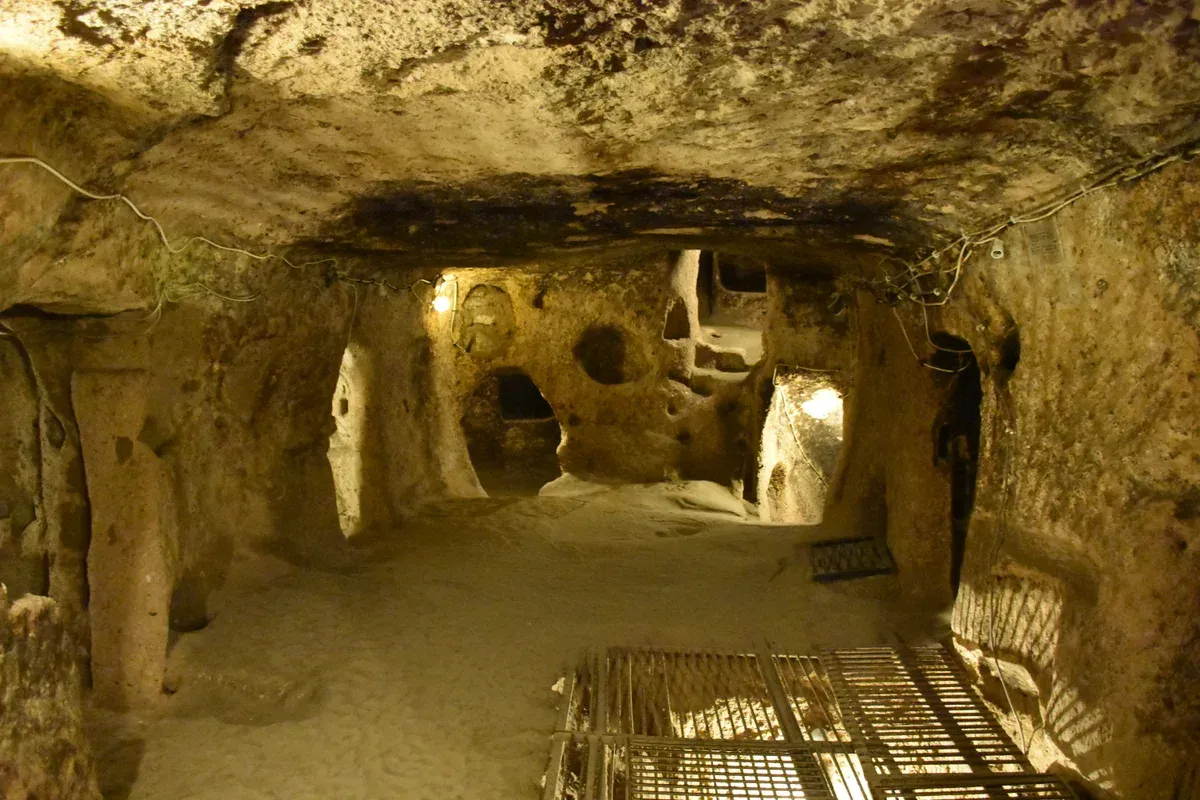
Photo: MusikAnimal, CC BY-SA 4.0, via Wikimedia Commons
First floor: the stable and a millstone door
The visited route opens on the animal level. The stable sits on the first floor, and its small size is itself a clue: it suggests further stables in the sections not yet opened, since a refuge built for thousands needed more than one. To the left of the stable a passage closed by a millstone door leads into a church, and to the right lie rooms read as living spaces.
Livestock this high up is the same logic Derinkuyu used: keep the smell and the gases away from the levels below and borrow the animals' warmth in winter. It is also the floor where you set your pace, because everything above ground level you have already done by the time you are here.
Second floor: the church with two apses
The church on the second floor is the most explicit evidence of a community that expected to stay: a nave and two apses, a baptismal font in front of them, seating platforms along the walls. The names in the graves here coincide with those beside the church, which supports the reading that these were religious people buried at their workplace. Living spaces share the floor.
Practically, this is the widest chamber most visitors will stand in all day, and the moment claustrophobic readers should aim for: look at the ceiling height, then reconsider any worry you carried down the entrance stairs.
Third floor: granaries, presses and a copper workshop
Wikipedia calls the third floor the most important area of the compound: storage places, wine and oil presses, kitchens, and one genuinely strange object, a block of andesite with relief textures and fifty-seven carved holes, shown to have been used for cold-forming copper. The ore was probably mined in the country between Aksaray and Nevşehir, a source the much older settlement of Aşıklı Höyük had worked before them. A refuge city with an industrial floor is a refuge city planning on months, and the presses explain how.
This is the floor that rewards a guide or the history above, because nothing at the rope line labels the stone.
Fourth floor: the warehouses
The highest number of storage rooms and areas for earthenware jars sits on the fourth floor, and the quantity is the argument: Wikipedia reads the large storage area as evidence of economic stability, a community provisioned to outlast a siege rather than hide for a night. For the visitor it is the quietest stretch of the route, jar sockets and granary rooms in both directions. The descent ends here and climbs back through the same logic you came down by, which is worth knowing if someone in your party wants to stop at floor two: the circuit is forgiving of half-visits in a way the deep, one-way loops of Derinkuyu are not.
How Much Time To Give Kaymaklı
The Ministry states no visit length. HistoryHit's travellers' figure runs 2 to 3 hours, which is generous, so the routings below are ours with that range noted where it lands.
Four floors and a return climb make this a shorter visit than its neighbour, and the rooms are wide enough that the pace stays yours, not the queue's. Tour groups cycle through from mid-morning, which HistoryHit flags directly, and the evening opening means the emptiest slot of all costs you nothing but a late dinner.
| Routing | What you get | What it skips | Door to door |
|---|---|---|---|
| The short visit | Floors one and two: the stable, the millstone door and the two-apse church, the two most photographed stops | The granary floors, the presses and the andesite block | About 30–40 minutes |
| The full visit | All four open floors down to the warehouses and back up, reading the history above as you go | Nothing that is open to the public | 45–60 minutes, 2–3 hours if you take HistoryHit's unhurried pace |
| With a tour | A guide's commentary on the andesite stone and the church, the part of the site that explains itself worst | The standard tours route the day through Derinkuyu instead, so with Kaymaklı you are usually self-guided or private | An hour inside, full day for the private car and guide |
Hours: The Evening Opening Is The Point
Kaymaklı opens 08:00 to 20:00 every day, with the ticket office taking sales to 19:15 and no weekly closed day. In a region where the big sights shut between 18:45 and 19:00, that extra hour is a scheduling tool: a 17:00 arrival has the floors mostly to itself after the day tours leave, and in summer you surface into golden light instead of the mid-afternoon glare. The same religious-holiday rule applies as everywhere in the Ministry system, on the first day of Ramazan Bayramı and Kurban Bayramı the site opens only after midday.
The night session exists here too in the Ministry's evening-programme pattern, but the published evening ticket this guide's official sources carry is Derinkuyu's 19:00–21:00 session, so do not assume a ticketed night programme at Kaymaklı without checking the gate. On money, nothing to decide: the $14.90 (€13) gate ticket is the region's standard, and the MuseumPass Cappadocia e-card, $74.51 (€65) for 3 days with one entry per site, covers this gate like every other Ministry ticket in the region. The price and e-ticket detail for both cities is on the underground city tickets page. The official hours live on muze.gov.tr.
- Emptiest: after 17:00, once the day tours have gone north (our observation)
- Busiest: 10:00 to 13:00, when the tour circuit cycles through
- Last practical entry: by 19:00, for a fast 45 minutes below
| Session | Hours | Who it is for | Ticket |
|---|---|---|---|
| Day session | 08:00–20:00, ticket office to 19:15, every day | All visitors | $14.90 (€13) |
| Quiet window | From about 17:00, after the tour circuit | Anyone who can schedule late | Standard ticket |
| Religious-holiday first day | Opens after midday only | All visitors | Standard ticket |
How To Get To Kaymaklı
By road, short from Nevşehir, half an hour-ish from Göreme
The city sits in the village of Kaymaklı, 19 km from Nevşehir on the Nevşehir–Niğde road, which makes it the underground city closest to the provincial capital rather than to Göreme. From Göreme the drive runs via or around Nevşehir, call it half an hour with the last kilometres climbing through the village's own streets, an estimate from the GPS distances rather than an official figure. The clean self-drive day is Kaymaklı first, then the north loop's Paşabağ and Avanos, or the double-underground day set out on the tickets page.
The day trips from Göreme hub sorts the variants.
By dolmuş through Nevşehir's otogar
Public transport works here better than the region's reputation suggests: HistoryHit's route is the one locals use, ride any Göreme–Nevşehir minibus to the otogar, find the central dolmuş stand, and board a service marked for Kaymaklı or the Derinkuyu cooperative, which drops you in the village centre. Departures run about every half hour through the day, from 07:30 to around 19:10 on that source's reading. The finding to plan around: no official fare table or timetable is published online for any of these rural lines, so carry small lira notes and confirm the last return at the otogar, not on your phone.
The regional picture is on getting around Cappadocia.
At Kaymaklı: What To Do, And What Not To
Every line here is a decision argued somewhere above, compressed into the form you can act on that afternoon.
Do
- Come at 17:00 or later in season and have the floors with the tour groups gone
- Use this as the first underground city if tight spaces worry you, the rooms are the forgiving ones
- Read the floor guide above before the andesite block, nothing on site explains the fifty-seven holes
- Leave the daypack at the hotel, the connecting passages are the pinch points
- Pair it with Derinkuyu the same day if you are driving, ten road-minutes apart and open until 20:00
Don't
- Do not judge the whole site by the entrance stairs, the first pinch opens into the widest rooms of any refuge in the region
- Do not arrive expecting the green tour to include this stop, the standard guided day routes to Derinkuyu and Ihlara
- Do not count on an evening ticketed programme here, the published night session in the Ministry system is Derinkuyu's
- Do not lean on or roll the millstone doors, they are original load-bearing archaeology
- Do not plan the dolmuş return past 19:10 without checking at the otogar, timetables are unpublished
Five Things Most Visitors Do Not Know About Kaymaklı
All five come from the sources this page cites, and each one changes what you look at downstairs.
- The village still uses it. The houses of Kaymaklı stand around nearly one hundred tunnels, and locals use the tunnels today as storage areas, stables and cellars, which is why the place reads lived-in rather than excavated [Wikipedia, Description section]. - There was a factory on floor three. The andesite block with fifty-seven carved holes was used for cold-forming copper, probably from mines between Aksaray and Nevşehir that the Neolithic settlement of Aşıklı Höyük had worked thousands of years earlier [Wikipedia, Description section]. - The graves have names. The burials beside the second-floor church carry names matching those in the graves next to it, read as religious people buried at their own workplace [Wikipedia, Description section]. - It was tied to Derinkuyu by an umbilical. 8–9 km of tunnels connected the two cities, one system with two mouths, though no visitor today walks any of it [Wikipedia, History section]. - It opened before its famous neighbour. Kaymaklı admitted tourists in 1964, a year before Derinkuyu's 1965 opening on the state tourism portal's dating, which surprises everyone who assumed the deep one came first [Wikipedia lead and HistoryHit].
Kaymaklı Underground City Map: The Entrance And The Pairing Stops
The ticketed entrance in the village, with Derinkuyu to the south and the Ihlara gorge beyond it, the full underground pair in one ring.
Next Stop From Kaymaklı
Drive times are our estimates from the GPS distances, and the roads here are good two-laners all the way.
Derinkuyu Underground City
Ten minutes south and the character flips entirely: same $14.90 (€13) ticket, but the deepest and largest excavated of the cities, 18 levels dropping more than 85 m through passages that ask you to stoop. Derinkuyu tells you what your shoulders are in for.
about 10 min by road Read the guideIhlara Valley
The south-loop pairing: a river gorge with rock-cut churches along a walkable 4 km section from the Ihlara village gate, ticket $17.19 (€15) including the Selime entrance. Ihlara Valley covers the gates and the hike.
about 1 h by road Read the guidePaşabağ
The north-loop partner for the drive back toward Göreme: mushroom-capped fairy chimneys on the Zelve–Paşabağ combined ticket, $13.76 (€12) for both sites, open to 20:00. Paşabağ has the visit, and the churches at Zelve that stay closed.
about 35 min by road Read the guideKaymaklı Underground City Questions
Which underground city is better in Cappadocia?
They charge the same official $14.90 (€13), so better means fitter to you. Kaymaklı: 4 of 8 levels, wide shaft-lit rooms, open to 20:00, the calmer visit for anyone unsure about tight spaces. Derinkuyu: 18 levels, more than 85 m deep, the full descent, tighter and busier. The decision table above is the short version, and the honest answer is that one day can hold both.
How many floors of Kaymaklı are open?
Four of 8 levels, per the state tourism portal, with the official wording honest that only a fraction of the complex is visitable. The route runs stable, church, presses and copper-working stone, then warehouses, and the floor-by-floor walk is set out in the section above.
How much does Kaymaklı cost, and can I pay at the door?
$14.90 (€13) for an adult foreign visitor, the same figure charged at the gate and on the official e-shop, whose tickets are undated. Turkish citizens 18 and under and 65 and over enter free via the state app. The full comparison of entry routes, including the tours that bundle a ticket as an optional extra, is on the underground city tickets page.
Is Kaymaklı claustrophobic?
Less than most visitors expect. The connecting tunnels run lower and steeper than Derinkuyu's, but the rooms themselves are organised around ventilation shafts and read wide, and HistoryHit's verdict is that even visitors who dislike confined spaces tend to feel at ease. If you want the strongest test removed entirely, stop after the second-floor church, where the widest chamber of the visit sits.
Can you visit Kaymaklı and Derinkuyu in one day?
Easily, and it is a better plan than choosing. They sit about ten road-minutes apart, the tickets are the same price, and the hours stack: Derinkuyu at 08:00 before the coaches, the Ihlara gorge midday if you drive south, then Kaymaklı after 17:00 on the way home while the north's sights are shutting. The worked version is on the tickets page.
How do I get to Kaymaklı without a tour?
Dolmuş with one change: any Göreme–Nevşehir minibus to the otogar, then a Kaymaklı or Derinkuyu-cooperative service from the central stand, roughly every half hour from 07:30 to about 19:10. No official fare table is published for these rural lines, so carry small lira notes. The regional transport picture is on getting around Cappadocia.
What is the secret underground city in Turkey called?
If you mean this one, its ancient name was Enegup, to Cappadocian Greek speakers Anakou, and the modern village of Kaymaklı grew up around its hundred tunnels. Derinkuyu's was Malakopi. Neither was secret to its neighbours, both were shelter for thousands, and the region holds dozens more, from Özkonak to the vast, still-being-excavated find under Nevşehir itself.
Where Kaymaklı Fits In A Cappadocia Day
Kaymaklı wins two slots. The self-drive day: the two underground cities back to back, Derinkuyu at 08:00, Kaymaklı from 17:00 with the Ihlara gorge or a long lunch between, a shape the day trips from Göreme hub and the three-day Göreme itinerary both build around. And the slow evening: it is the only ticketed sight in the region with a ticket window open past 19:00, which rescues a day the balloons cancelled, and the Cappadocia balloon weather page explains why every itinerary needs one of those.
The things to do in Göreme list ranks the rest, the Göreme map pins it, and the Göreme city guide homepage holds the whole plan.
Kaymaklı On Film: The Closest Look Before You Go
This page reuses the Derinkuyu film set, the closest verified footage to Kaymaklı's world, because the two cities share one engineering story. Watch for the millstone doors and the shaft-lit rooms, which is exactly what you will stand in front of here.
Inside the Underground City once Housed 20,000 People: Derinkuyu
A full walk of the sister city, and the best available preview of the refuge system Kaymaklı shares.
Video: Discover With Ruhi CenetDerinkuyu Underground City 4K Cappadocia Turkey
A quiet 4K walkthrough whose steady frames show chamber widths, the thing Kaymaklı readers worry about most.
Video: Cappadocia Page TurkeyInside the Mysterious Deep-Underground City of Derinkuyu
A deep dive into the ventilation and door engineering both cities were built around.
Video: Bright InsightVideos load from YouTube only when you press play.
Prices, hours and terms are set by the venue or operator and confirmed at checkout.
We may earn a commission if you book through one of our links, at no extra cost to you. Full affiliate disclosure